
Hair transplant recovery timeline at a glance
A hair transplant recovery timeline is not a straight line. The scalp can look more settled before the transplanted hairs shed, and visible growth may remain limited for several months. That does not, by itself, indicate a problem. The table below is a general orientation rather than a prediction of an individual result.
Tenderness, redness and swelling can occur while the newly placed grafts are at their most vulnerable.
Crusting or scabbing gradually settles. Washing and scab-care instructions should come from your clinic.
Many transplanted hairs shed. The follicles remain beneath the skin and may later produce new hair.
New hairs may begin to appear unevenly and can initially look fine, short or inconsistent.
More growth and visual change commonly become noticeable as hairs lengthen and mature.
Texture, length and overall appearance can continue to develop, especially in slower-growing areas.
Stage 01
Days 1–3: protecting the newly transplanted grafts
The first few days are mainly about protection. Mild soreness, tightness, redness or swelling can be part of the early postoperative period. Small crusts may begin to form around the recipient sites.
Avoid touching, scratching or rubbing the grafted area. Sleep position, sprays, medication, bandage removal and the timing of the first wash vary by clinic and procedure, so use the exact plan supplied by your surgical team.
Your clinic knows the technique used, your medical history and how your procedure went. General hair transplant aftercare information should never override its instructions.
Stage 02
Days 4–7: the first week of healing
During the rest of the first week, swelling often starts to settle and the recipient area may look dry or crusted. Itching can occur as the skin heals, but scratching can disturb the area.
Washing and protecting the scalp
Some clinics introduce gentle washing during this period, while others use a different schedule. Use only the method and products your clinic recommends. Avoid high water pressure, forceful rubbing and picking at crusts.
Ask your clinic when it is safe to return to exercise, wear headwear, sleep normally or expose the scalp to sun. These instructions can differ depending on the procedure and your recovery.
Stage 03
Days 7–14: scab removal and a calmer scalp
Crusts commonly loosen as healing progresses. Many clinics provide a specific washing or massage routine for the scab-removal period. Do not force scabs away before your clinic says it is appropriate.
By the end of the second week, the scalp may look considerably calmer, although lingering redness can last longer for some people. Donor-area sensations, dryness and temporary numbness may also take time to settle.
The NHS notes that temporary scabbing is common and that any non-dissolvable stitches are often removed around 10–14 days, where applicable. Your own surgeon’s timetable remains the one to follow.
Stage 04
Weeks 2–8: shedding and shock loss
Shedding is one of the most confusing hair transplant healing stages. Transplanted hair shafts often fall out during the first several weeks. This is commonly called shedding or shock loss and does not necessarily mean the follicles have been lost.
The appearance can temporarily seem thinner than expected. Because the timing and amount of shedding differ, comparing your scalp day by day—or comparing yourself with someone else—can create unnecessary worry.
Visible hair above the skin and the follicle beneath it are not the same thing. Shedding of the hair shaft can occur before later regrowth.
Stage 05
Months 2–3: the quiet phase
For many patients, months two and three bring limited visible change. The scalp may have healed well while new growth has not yet become obvious. This gap between surface healing and visible regrowth can be emotionally difficult.
Continue with the aftercare or treatment plan agreed with your clinic. Do not start, stop or change medication based solely on a general online timeline. If the scalp remains unusually painful, inflamed or is becoming worse rather than settling, contact your clinic.
Stage 06
Months 3–6: early growth begins
New hair often begins to appear during this broad window. Early growth may be patchy, fine, lighter in colour or different in texture. Individual hairs do not all enter their growth phase at the same time, so unevenness is common.
The NHS describes new hair as usually beginning to appear after roughly four months. Some patients notice changes earlier and others later. Photographs taken under consistent lighting and angles can make gradual progress easier to recognise than frequent mirror checks.
Stage 07
Months 6–12: length, coverage and density develop
Between six and twelve months, growth commonly becomes easier to see. Hairs can become longer and stronger, and the overall appearance may gain more coverage. Progress can still be uneven across the recipient area.
Different parts of the recipient area can appear to develop at different rates, and the speed of maturation varies. A result should not be judged from one photograph, one month or another patient’s experience.
Continue attending any follow-up appointments offered by your clinic. They are better placed to assess healing, growth and whether anything needs attention.
Stage 08
Months 12–18: later maturation
By twelve months, many patients have seen substantial growth, but development can continue. Hair calibre, texture, length and the way the result blends may change further during months twelve to eighteen.
The NHS gives a broad 10–18 month window for the full result to become visible. That range illustrates why patience matters: a single deadline cannot describe every person, technique or treated area.
When should you contact your clinic or a medical professional?
It is better to ask your clinic when something feels wrong than to rely on a generic timeline. Contact your clinic promptly if you experience symptoms that are severe, unexpected or worsening, including:
- increasing pain rather than gradual improvement
- spreading or worsening redness, warmth or swelling
- pus, an unpleasant discharge or a bad smell
- persistent or heavy bleeding
- fever, feeling significantly unwell or another concerning change
Seek urgent medical help when symptoms are severe or you believe there may be an emergency. A website or recovery app cannot diagnose complications.
How to track hair transplant progress realistically
Recovery is easier to evaluate when observations are consistent. Consider taking private photographs at planned milestones using the same angle, lighting, distance and hairstyle. Monthly comparisons are often more useful than daily checks.
Keep notes about questions you want to raise with your clinic, and record the dates of important instructions or follow-ups. Tracking should support communication and perspective—not replace professional assessment.
Recovery companion
Follow Day 1 to Month 18 with GraftGuide
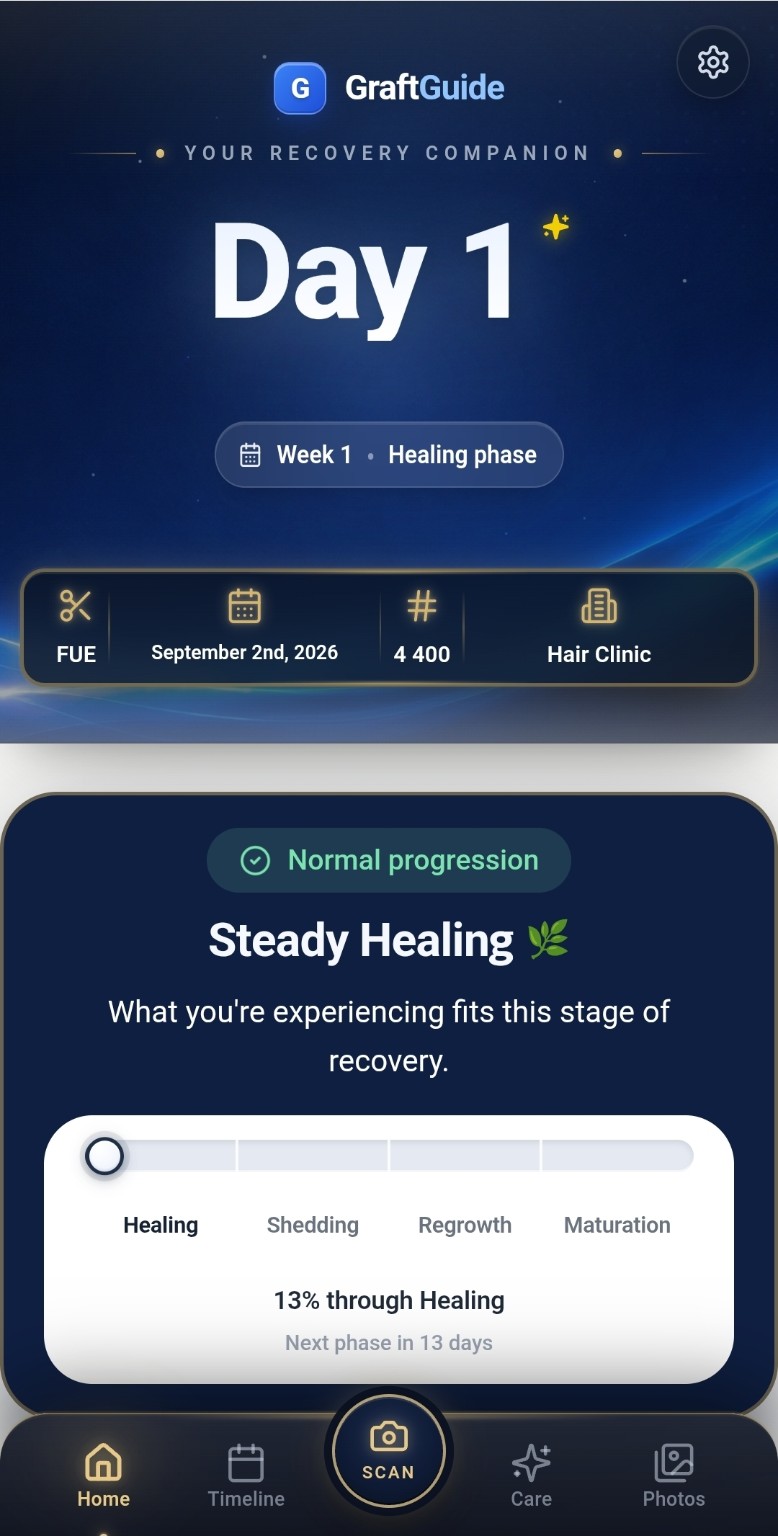
GraftGuide is a dedicated hair transplant recovery app that organises stage-specific guidance, aftercare information, recovery checks and private photo progress tracking across the recovery journey.
It provides general information and reassurance, but it does not diagnose conditions or replace instructions from your clinic or a medical professional.
Hair transplant recovery questions
How long does hair transplant recovery take?
The surface healing period is much shorter than the full growth timeline. Early healing commonly occurs over days and weeks, while visible growth and maturation can continue for 10–18 months. Your clinic can explain what is expected for your procedure.
When do transplanted hairs start growing?
New growth often becomes noticeable around months three to four, but timing varies. Early hairs may be fine and uneven before they mature.
Is shedding after a hair transplant normal?
Shedding of transplanted hair shafts during the first several weeks is common. If the scalp itself is painful, increasingly red, swollen or otherwise concerning, contact your clinic rather than assuming it is part of normal shedding.
Sources and further reading
This overview is educational and intentionally general. For clinical information, see the NHS hair transplant guidance and the medically reviewed Cleveland Clinic hair transplant overview. Always use the personalised aftercare plan provided by your own clinic.